Angel Dorothy by Jane Brown
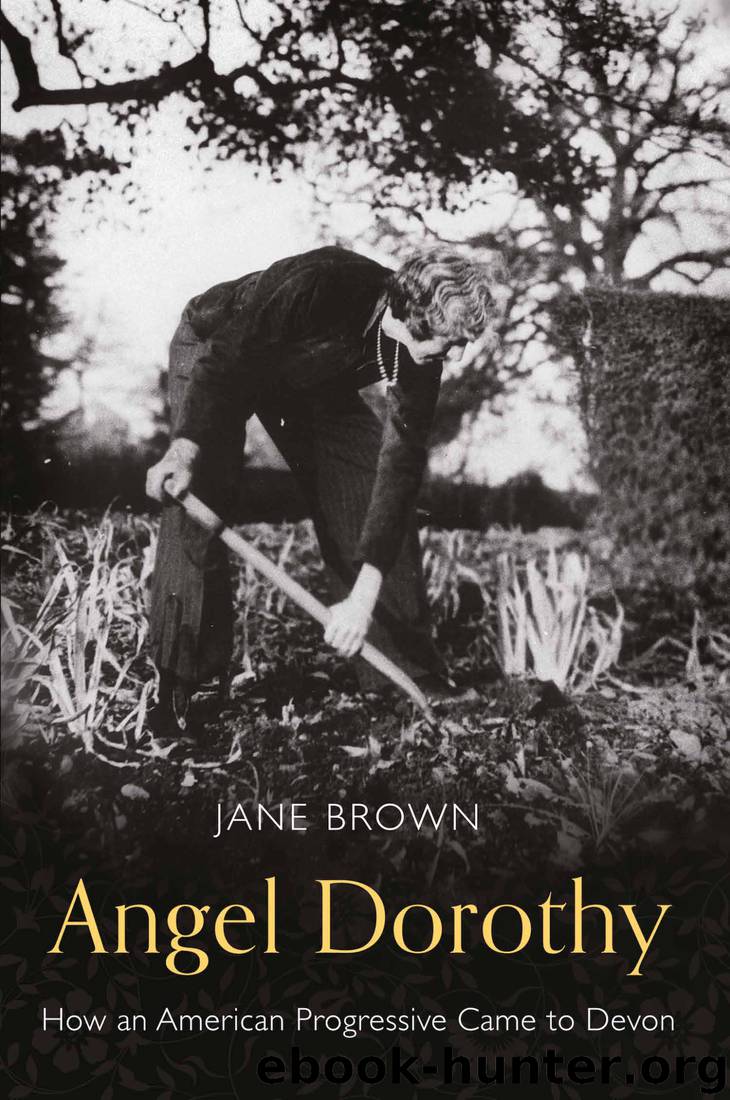
Author:Jane Brown [Brown, Jane]
Language: eng
Format: epub
Publisher: Random House
Published: 2017-01-31T12:07:23+00:00
Ten: Mischa and The Possessed
Since the holiday in Scotland Michael had been at home and working at campaigning on behalf of the Independent Labour Party in Totnes, an occupation arranged for him by Leonard and Headmaster Curry at Dorothy’s request. In early October she went to Cambridge to see him settled into what would be his fourth year and she was pleased to find he had friends outside college, with an Anglo-American academic family, the Cromptons, with three daughters. Michael was smitten with Belinda, the youngest.
Dartington’s Chekhov Studio opened on 2nd October 1936, and Dorothy was soon absorbed in explaining to the trustees and the world in general what this was all about. As she had once before, just ten years earlier, typed out the prospectus for the school, now she did so for the Studio, beginning with Chekov’s experience:
As a young man of twenty he entered the Moscow Arts Theatre under the direction of Stanislavsky. It is here that he learned to prepare the parts that later made him famous in Russia, and from Stanislavsky he learned also the value and importance of a method. Chekhov’s name became synonymous with the great roles he created [including Khlestakov in The Government Inspector, Malvolio in Twelfth Night and Hamlet].255
She noted that as director of the Second Moscow Arts Theatre Chekhov ran ‘an organization of nearly two hundred people’ for four years from 1923. ‘His aim was to deepen and ennoble the work of the Theatre,’ and he found the plays of Shakespeare most rewarding, enlarging the repertory to include King Lear and The Taming of the Shrew, alongside the Russian classics. ‘Leaving Russia in 1928 he determined to study at closer range the European theatre – he worked in Germany with Max Reinhardt, and then in Paris and in Riga.’
Dorothy only wrote of her own feelings at the opening of the Studio in 1936 in her 1959 memoir. In 1936 she clearly felt that she had to justify the introduction of this avant-garde Actors Studio and present it as part of their steady progress. She started with her own love of the theatre as a means of ‘refreshment and renewal’, she recalled Maurice Browne and Journey’s End, Richard Odlin and their attempts at open-air performances including Milton’s Comus, Nellie Van and her productions of Ibsen, especially A Doll’s House, and their newly refurbished Barn Theatre, and continued:
For me [this] all leads up to the day when Mr Chekhov came to Dartington – one day [afternoon of Monday 12th October] I went over as a visitor to his class. Several people were sitting with me on the little balcony and I watched an exercise. Mr Chekhov was showing the different qualities of emotion in the way we approach someone. He walked across to Esme Hubbard in one tempo, and then in another, taking her hand and saying ‘how are you?’ It was a simple exercise, but what he gave to it was such a revelation to me that I knew I had met the man who was for me, the Master.
Download
This site does not store any files on its server. We only index and link to content provided by other sites. Please contact the content providers to delete copyright contents if any and email us, we'll remove relevant links or contents immediately.
Cecilia; Or, Memoirs of an Heiress — Volume 2 by Fanny Burney(31921)
Cecilia; Or, Memoirs of an Heiress — Volume 3 by Fanny Burney(31906)
Fanny Burney by Claire Harman(26574)
We're Going to Need More Wine by Gabrielle Union(19011)
Plagued by Fire by Paul Hendrickson(17383)
All the Missing Girls by Megan Miranda(15838)
Cat's cradle by Kurt Vonnegut(15279)
Bombshells: Glamour Girls of a Lifetime by Sullivan Steve(14029)
For the Love of Europe by Rick Steves(13722)
Leonardo da Vinci by Walter Isaacson(13262)
4 3 2 1: A Novel by Paul Auster(12345)
The remains of the day by Kazuo Ishiguro(8916)
Adultolescence by Gabbie Hanna(8894)
Note to Self by Connor Franta(7647)
Diary of a Player by Brad Paisley(7531)
Giovanni's Room by James Baldwin(7284)
What Does This Button Do? by Bruce Dickinson(6178)
Ego Is the Enemy by Ryan Holiday(5370)
Born a Crime by Trevor Noah(5345)
